Prophetic Duck’s Display and Death
The RookThe prophetic duck’s presentation and death mark the brief, consequential culmination of the Checquy’s effort to find an animal capable of foretelling the future. The duck proves its ability in a private test with Rook Thomas, giving her a precise warning about imminent memory loss; at the Court’s dinner, however, Rupert Henderson’s insistence on extracting prophecy through traditional divination destroys the animal and exposes the gulf between demonstrable knowledge and misplaced expertise.
Search and Preparation
The duck was the unexpected success of an undertaking that had produced repeated embarrassment. Earlier supposed prophetic animals—including swine, a goat, a rabbit, and a Jack Russell terrier—had been presented to the Court without yielding any predictions. The search was among the duties Myfanwy inherited on becoming Rook, and she kept it going in part because it was one of Sir Henry Wattleman’s persistent interests. Once the team confirmed its find, scientists completed extensive tests, and Myfanwy sent formal invitations for the Court to dine at the Rookery and witness the United Kingdom’s only oracular duck.
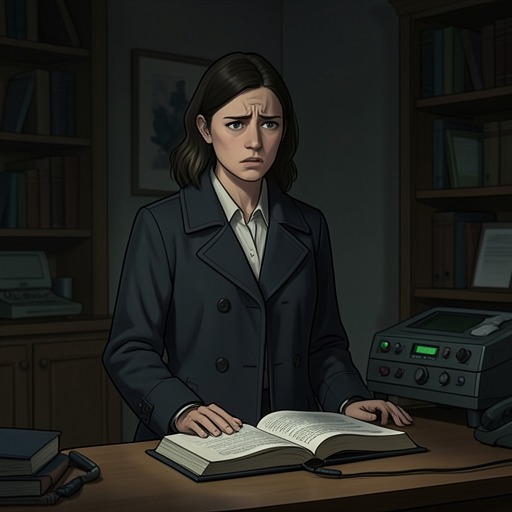
The discovery did not immediately reassure her. Past failures made her doubt that the team had truly found a prophetic animal, so she went to the laboratory to test whether the duck could communicate clearly and predict accurately. The staff arranged private access in a soundproof white room. The duck had an oversize keyboard adapted for its beak, a practical solution to the mismatch between beak and key size. Dr. Crisp explained that each person had only three yes-or-no questions, all to be asked in a single sitting.
The Three Questions
Myfanwy had a particular reason to test the duck’s accuracy: she already knew that predictions about her future had been made. She asked whether Checquy operatives would attack her. The duck pecked the Y key, and the answer appeared on the computer screen. This was not wholly new information to her, but the rapid response impressed her and established the duck’s ability to communicate through the prepared system.
She then asked whether she would be attacked in her house. The answer was no, relieving the specific fear that she might be attacked there while asleep or see her rabbit killed. One question remained. Myfanwy asked whether she would lose her memory within a month, and the duck answered yes. The prediction transformed a more indefinite expectation that she would lose everything into a short, usable deadline: she understood that she had weeks at most and began recalculating what she could accomplish before her memory disappeared. The duck thus supplied not merely a marvel for the Court to inspect but information that immediately altered Myfanwy’s sense of the time available to her.
The Court’s Demonstration
That evening, the Court assembled at the Rookery for dinner. Sir Henry presented the occasion as the result of years of research and fieldwork, and introduced Rupert Henderson as a figure whose reputation and supposed clairvoyance qualified him to participate. Henderson did not understand the Checquy’s actual familiarity with the supernatural. He addressed its members as though they were military-intelligence officials who had stumbled upon a mystical relic, while the Court—apart from Sir Henry—responded with visible impatience and skepticism.
Sir Henry announced that Henderson had confirmed the duck was the creature the Checquy had sought. He also said that the prophecy would be highly significant and that only he and Lady Linda Farrier should witness it, with the two heads of the organization deciding what information could be shared. This change of plan made the demonstration less a collective scientific test than a controlled disclosure. Dr. Crisp informed Rook Thomas that the duck was ready in the next room and asked whether the whole Court would be present. Myfanwy introduced Henderson to Dr. Crisp, who could provide the results already obtained from the animal, but Henderson declined the assistance, preferring not to have his impressions influenced.
Death and Reversal
The expectation of a useful, perhaps enduring source of foresight ended abruptly when Henderson came out of the duck’s room with blood on his hands and feathers in his hair. He announced that the duck had told him nothing. Asked why he had killed it, he explained that he had followed traditional procedures: in his understanding, the auguries were revealed through the creature’s death and examination of its entrails. The other Court members reacted with shock and anger; Bishop Alrich questioned his decision, while Chevalier Eckhart pointed out that modern imaging could have been used instead.
The decisive reversal came when Gestalt stated that the Checquy had already established that the duck could answer spoken questions accurately. Henderson’s method had not uncovered a hidden prophecy; it had destroyed an animal whose capacity had already been tested. His confidence in inherited ritual stood against the organization’s direct evidence, and the cost of that conflict was irreversible: the duck was dead, and Henderson had obtained no new information from it. The episode ends the demonstration not with the promised revelation but with the exposure of a basic failure to attend to what the Checquy already knew.
Significance
The event sets two ways of claiming knowledge against each other. Myfanwy’s private test works through a limited, explicit procedure: three questions, yes-or-no answers, and results displayed on a computer. Henderson instead treats prophecy as something that must be elicited through a traditional ritual, disregarding both the available technology and the verified method. His failure is not simply that he receives no prophecy; it is that his assumptions prevent him from recognizing an answerable source of information before it is lost.
The duck’s brief appearance also links the public and private stakes of prophecy. For the Court, it represents the culmination of a long and often embarrassing search, and a possible means of learning about future events. For Myfanwy, its most important answer is immediate and personal: she will lose her memory within a month. The demonstration therefore carries a certainty that its official celebration cannot contain. The animal does not survive to serve the organization, but its answers have already changed how Myfanwy understands the narrow interval before her memory loss.